Rising electricity prices? Why charging at home is still a good choice
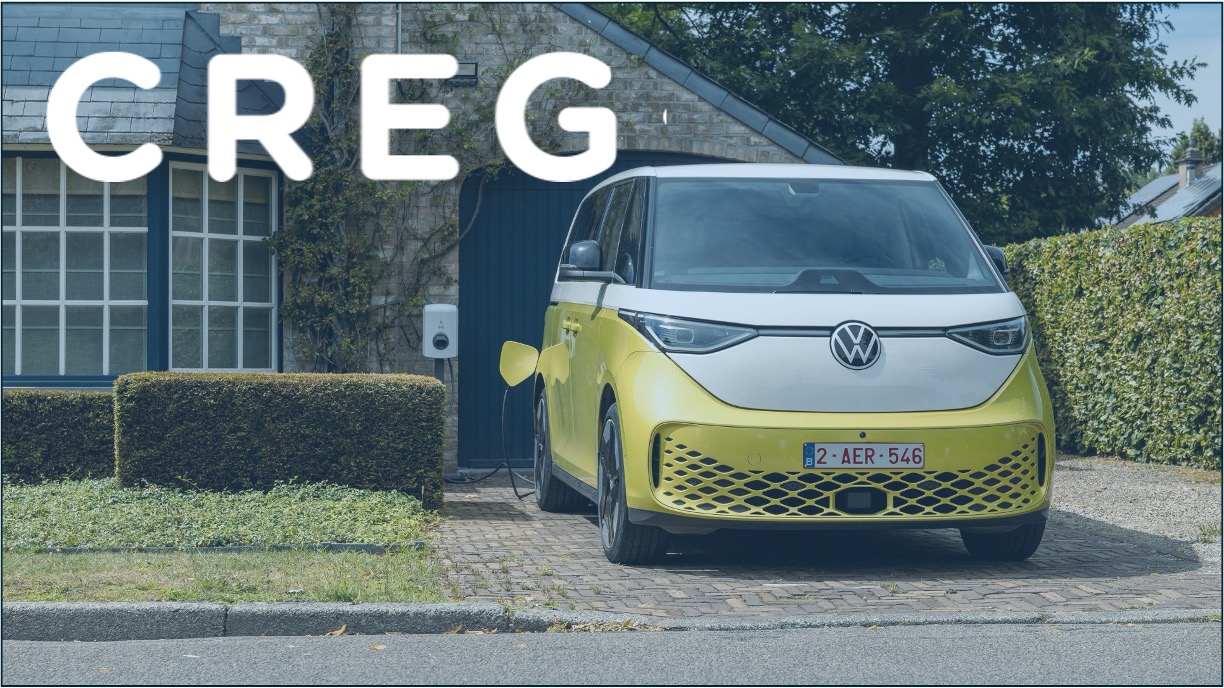
Rising electricity prices? Why charging at home is still a good choice
Electricity prices are currently rising. You may notice that your home charging reimbursement doesn’t always cover your full electricity cost at the moment. That gap is real, and we understand it raises questions. In this article, we explain where the gap comes from and what you can do yourself to keep your charging costs down.
In short: the gap arises because the flat-rate CREG tariff responds to changes in the electricity market with a delay. Over a longer period, the differences can partly even out. With a competitive energy contract and smart charging, you can also limit your own costs.
How the CREG tariff works
Your employer reimburses your home charging sessions at the CREG tariff. This is a maximum flat rate per kWh, set every quarter for each region based on data from the energy regulator CREG. It is based on the average electricity price across all households, not on your personal contract.
Because the quarterly rate is calculated from average prices in earlier months, with a two-month delay, the reimbursement lags behind fast market movements. We’re seeing that clearly in Flanders right now.
So when prices rise, you temporarily get back a little less than you pay. But it works both ways. As soon as prices fall, the CREG tariff stays above the market price for a while, and you get back more than you pay. Over a longer period, those differences can therefore partly even out. A clear correction is already on the way in January: in Flanders, the rate rises from 32.25 to 36.16 cents per kWh, which considerably narrows the current gap.
Tip 1: compare your energy contract
The CREG tariff is an average. Do you structurally pay more than the CREG tariff? Then it may be worth checking whether your current energy contract is still competitive. Your grid area, consumption profile, solar panels, fixed fee and capacity tariff can also affect your final cost.
- Compare for yourself. With the V-test from the Flemish utility regulator, the Brusim in Brussels or the Compacwape in Wallonia, you can see in a few minutes which contracts suit your consumption profile.
- Get support. There are also services, such as June Energy, that monitor energy contracts and can help you switch to a better deal on a regular basis.
If you have a fixed contract, whether the reimbursement is enough depends on your own rate. If your fixed price is below the CREG tariff, you’re actually coming out ahead right now.
Tip 2: charge smart
It’s not just your contract that determines what you pay, but also when and how you charge.
- Use smart charging in the Blossom app. Your car will then charge at cheaper times as much as possible. This pays off especially with a dynamic energy contract, where the electricity price changes throughout the day. With a day/night tariff, charging during off-peak hours can also save you money.
- Limit the charging power where possible. Your capacity tariff is partly determined by your highest average quarter-hour peak. So you don’t always need to charge at 11 kW: if your car is at home all night, a lower charging power is often enough.
- Avoid charging during peak moments at home. Preferably don’t charge while the oven, washing machine or heat pump is running.
Summary
- The gap between your costs and your reimbursement is real. Because of the delay in the CREG mechanism, it can partly even out as prices move later on. From January, the Flemish rate already rises from 32.25 to 36.16 cents per kWh.
- Do you structurally pay more than the CREG tariff? Check whether your energy contract still suits your consumption profile.
- With smart charging and a limited charging power, you keep your own costs low.
- Charging at home and at the office remains, in most situations, the most efficient way to charge your electric car. Public charging is mainly the right choice when you need extra energy on the road.
We will keep looking at how to make home charging as simple, smart and cost-efficient as possible, and how the reimbursement can better match actual charging costs in the future. We’ll come back to this later.
Questions about your own situation? Contact your fleet manager or reach Blossom through the app.
Gerelateerde artikels

Why TCO is not enough and TCU gives the real answer
Is electric driving really cheaper? For many companies and drivers, that is an important question today. The answer depends largely on how an electric car is used and charged in practice.
It is often said that driving electric is cheaper than driving a petrol or diesel car. But is that really true?
The honest answer is less black and white. In some situations, electric driving is indeed cheaper. In others, it is not. It all depends on charging behaviour, usage patterns and how costs are calculated.
Why electric driving looks cheaper on paper
Recent figures show that the cost per kilometre of electric cars is often lower than that of fossil-fuel vehicles. Especially when drivers can charge at home, the difference can be significant.
But as soon as drivers become more dependent on public charging points or fast chargers, that picture can change quickly. In many cases, the cost moves closer to that of petrol or diesel — and can sometimes even be higher.
And that is exactly where the problem lies: many comparisons focus only on energy costs.
The limitation of TCO
The total cost of a car obviously consists of more than energy consumption alone. That is why companies often look at Total Cost of Ownership (TCO).
TCO provides a more complete picture because it takes into account factors such as:
- purchase price
- maintenance
- insurance
- depreciation
- fuel or charging costs
This makes TCO a better method for comparing vehicles.
However, TCO also falls short when it comes to electric mobility.
Why? Because TCO works with averages, while reality can differ significantly from one driver to another.
From theory to reality: TCU
That is why another KPI is gaining importance: Total Cost of Use (TCU).
Where TCO predicts what a car should cost, TCU shows what that car actually costs in day-to-day use.
TCU takes into account:
- where someone charges
- when charging takes place
- how many kilometres are driven
- which types of charging points are used
- which tariffs are paid
- which choices are made on the road
As a result, two identical electric cars can ultimately have a completely different total cost.
The impact of charging behaviour on the cost of electric driving
Charging behaviour has a major impact on the final cost of electric driving.
One driver mainly charges at home and keeps costs low. Another frequently uses public charging points or fast chargers and sees energy costs rise quickly.
Electric driving is therefore not automatically cheaper.
It becomes cheaper when it is used in the right way.
When is electric driving cheapest?
In practice, electric driving is financially most attractive for drivers who:
- can charge at home
- can charge at work
- make conscious choices about when they charge
- limit fast charging where possible
Drivers who mainly depend on public charging points or regularly use fast chargers often see the financial advantage decrease significantly.
The cost of electric driving is therefore determined not only by the car itself, but also by where, when and at what tariff it is charged.
Why TCU is crucial for companies and fleet managers
For companies and fleet managers, this difference becomes even more relevant.
Not because the technology works differently, but because employees’ charging behaviour can vary significantly. A fleet of identical electric cars can therefore show major differences in actual usage costs.
Without insight into that behaviour, it becomes difficult to keep total charging costs under control.
By making charging behaviour visible and adjusting it where needed, companies can reduce costs without having to change their entire fleet strategy.
From insight to action: the role of data in fleet management
For fleet managers, the story does not end with the decision to go electric. The real challenge only begins afterwards.
Without insight into:
- charging behaviour
- charging points used
- charging tariffs
- usage patterns
the actual cost of an electric fleet remains difficult to predict — and even harder to optimise.
That is why more and more organisations are moving from static reporting to real-time insights into their fleet.
At Blossom, we help fleet managers make exactly that difference. By making charging behaviour, charging costs and usage patterns transparent, companies gain insight into their actual costs as well as concrete ways to optimise them.
Not through complex theoretical models or assumptions, but based on real-world data.
This enables companies to:
- keep charging costs under better control
- make more informed decisions
- guide employees towards more efficient charging behaviour
- structurally optimise their EV strategy
Frequently asked questions about electric driving
1. Is electric driving always cheaper?
No. The cost of electric driving depends heavily on charging behaviour, the type of charging points used, the tariffs paid and the number of kilometres driven. Drivers who mainly charge at home or at work can generally drive electric more cheaply than those who frequently use public charging points or fast chargers.
2. What is the difference between TCO and TCU?
TCO (Total Cost of Ownership) calculates the total ownership cost of a car based on factors including purchase, depreciation, maintenance, insurance and energy.
TCU (Total Cost of Use) looks at what a car actually costs in practice, based on real usage and actual charging costs.
3. Why are public charging points often more expensive?
Public charging points, and fast chargers in particular, often apply higher tariffs than charging at home or at work. Frequent public charging can therefore significantly increase the total cost of electric driving.
4. When is electric driving financially most attractive?
Electric driving is generally most attractive for drivers who can regularly charge at home or at work, make conscious choices about when they charge and limit the use of more expensive fast chargers.
Conclusion: is electric driving cheaper?
Electric driving is not a simple calculation.
It is not about one figure or one comparison, but about the combination of technology, usage, charging costs and behaviour.
TCO helps companies make the right choice when purchasing a car.
TCU determines whether that choice also pays off in practice.
And that is exactly where the difference is made today.
Discover the real cost of electric driving with Blossom
Want to know what electric driving really costs within your fleet?
With Blossom, you gain insight into charging behaviour, charging costs and usage patterns, so you can see not only where costs arise, but also where you can optimise.
Discover how Blossom helps you manage your electric fleet more intelligently and cost-efficiently.

In a recent study, the CREG warns about an oversupply of solar power, especially on sunny days. This means there’s a lot of cheap electricity available during peak solar production times. Perfect timing, then, to plug in your electric company car at home. You pay less while also helping to relieve the electrical grid: that’s a real win-win!
Making use of surplus solar energy
During periods of low demand and high solar production, there’s an excess of cheap electricity that puts pressure on the grid. The CREG emphasizes that flexibility in energy consumption is essential. By charging during the day, you as a home worker can take full advantage of this cheaper energy and at the same time reduce the load on the grid. With a dynamic energy contract, this can even lead to reimbursements.
Smart charging times and cost savings
Where traditionally night-time charging is the norm, charging during the day can be more financially advantageous. With a dynamic energy contract, you benefit from low rates during periods of solar energy surplus. This can even result in reimbursements, saving you even more. By aligning your charging behavior with the supply of renewable energy, you not only reduce your costs but also contribute to a more efficient energy system.
Ecological benefits
Charging during the day means making greater use of renewable energy and being less dependent on fossil fuels. This helps reduce CO₂ emissions and contributes to more sustainable energy consumption. For companies with electric vehicles, this is also an opportunity to shrink their ecological footprint and project a green image to clients and partners.
Blossom: smart home charging and energy management
At Blossom, we develop smart charging solutions to help you optimize your energy consumption.
- Coupling with solar panels: Have solar panels? Blossom maximizes the use of your own solar power to charge your vehicle, thereby lowering your grid consumption and costs.
- Insight into energy consumption: the app gives you insight into your charging sessions and home consumption, so you can charge smartly.
Charging during the day is saving money, going greener, and keeping the grid healthy. With Blossom, you have all the tools in hand to smartly align your charging strategy with the sun. Just plug in, and we’ll take care of the rest.

At Blossom, we believe that managing an electric fleet can be easier and smarter. That’s why we offer fleet managers an intuitive and reliable platform to effortlessly manage home chargers, charging cards and associated costs. No unnecessary complexity – just all the support you need to transition smoothly to a modern, sustainable fleet.
From invitation to installation
The Blossom platform starts by inviting employees who need a home charger or charging card. This process is completed in a few simple steps:
- The fleet manager enters the employee’s email address and they receive an invitation.
- The employee is guided to request their charging card and/or home charger on the platform.
- Our installation partner arranges the installation appointment.
- The fleet manager can track each employee’s progress through the installation process.
This approach ensures a streamlined onboarding experience while keeping the process simple and transparent.
Full visibility and control
Once the home charger is installed and the employee is fully ‘on board’, Blossom provides a detailed overview of all charging sessions, costs and any reimbursements. This gives fleet managers the insights they need to effectively monitor and manage energy consumption and associated costs. Clear reports and a user-friendly interface make it easy to optimise charging costs and fleet usage efficiently.
Discover how Blossom makes fleet management easier
From onboarding and installation to managing charging sessions and costs, Blossom’s easy-to-use solution saves fleet managers significant time and effort throughout the entire process. Whether you’re setting up a new electric fleet or optimizing an existing one, we’re here to help.
Curious about how we can improve your fleet management?
Contact us and see for yourself!
Together, we can make electric driving easy and worry-free.

The electric revolution is in full swing. More and more companies are offering their employees electric company cars as part of their sustainability strategy. But this transition also raises new questions: How does home charging work? And what are the tax implications? A recent circular from the Belgian Federal Public Service for Finance (2024/C/77) provides answers. At the same time, Blossom demonstrates how companies can seamlessly integrate this into their policies.
A look at the tax guidelines
Imagine an employee charging their electric company car at home. Who pays for the electricity? And what does that mean from a tax perspective? This is exactly what the circular clarifies. A distinction is made between electricity supplied directly by the employer and electricity paid for by the employee and reimbursed afterward.
In the case of direct supply, for example, through a charging card or a charging station at the office, the costs fall under the fixed taxable benefit of the company car. However, if an employee initially pays for the electricity costs themselves, the reimbursement is considered a separate taxable benefit—unless it concerns professional travel expenses. For commuting, employers can reimburse part of the cost tax-free, up to a maximum of €500 per year in 2026. Private kilometers, however, remain taxable.
The circular also provides a special exemption to facilitate the transition to electric driving. If a charging station is equipped with a system that accurately records the electricity used for the company car, the employer may reimburse these costs without additional taxation. A fixed rate per kWh, known as the CREG tariff, can even be used, simplifying administration as long as the rules are followed.
Practice: simplicity versus complexity
While the circular provides clarity, practical challenges remain. How do you accurately register the company car’s consumption? How do you ensure that employees are not taxed on their charging costs? And how do you keep the entire process transparent and fair? This is where technology and smart solutions become essential.
Blossom addresses these challenges by offering companies comprehensive charging solutions that not only comply with tax requirements but are also practical, user-friendly, and future-proof.
Blossom: bridging the gap between regulations and ease of use
At Blossom, simplicity is key. Our goal is to relieve companies and their employees of both technical and administrative burdens. We start with a high-quality home charging solution: reliable chargers designed with the whole family in mind. An employee can charge their company car, while other family members can use the charger for their private vehicles. The smart system automatically records the electricity used for the company car.
But Blossom goes even further. Thanks to our Fleet Dashboard, employers have real-time insight into each employee’s consumption. This allows for effortless reimbursements based on the CREG tariff. Additionally, all our home chargers are equipped with MID-certified meters, ensuring the highest standards of measurement accuracy. This guarantees that every kilowatt-hour charged is correctly recorded.
By combining technology with tax expertise, Blossom perfectly aligns with the requirements of the circular. Reimbursements are processed smoothly, with no surprises for employers or employees. The result? Less administrative hassle, happier employees, and a company ready for the future.
A step forward in sustainability
The transition to electric driving is more than just a technical adjustment; it’s a step towards a more sustainable world. With solutions like those from Blossom, this transition becomes simpler, more feasible, and more attractive—not only for employers looking to become more sustainable but also for employees who want to switch to electric driving worry-free.
Blossom proves that the future of mobility can be green, smart, and user-friendly. Curious about how we can support your company? We’re ready to help you build an electric mobility policy that works for everyone.
Want to learn more? Check out the circular here: MyMinfin

At Blossom, we love simplicity, efficiency, and smart technology. Your charging card is the key to hassle-free charging, but how do you keep it in top shape? A few smart habits can help prevent damage and ensure you can hit the road worry-free.
How does your charging card actually work?
Inside your card, a small antenna and an RFID chip draw power from the charging station’s signal.
This signal activates the chip, which then sends a unique code: “It’s me, and this is my key.” Once the charging station recognizes your key, charging begins. No batteries are required. The system is lightning fast and super energy efficient.
But because the antenna and chip are delicate, it’s important to handle your card with care. Here are the biggest pitfalls and how to avoid them.
Biggest mistake: Leaving your card in “the storage compartment”
Many drivers leave their charging card in the car’s storage compartment, right next to their wirelessly charging phone. Big mistake! Wireless charging creates an electromagnetic field that can damage your card’s antenna. This is one of the most common reasons charging cards stop working.
Other risks to your charging card
- Physical damage: Your card isn’t designed to be bent or scratched. Store it in a secure place, such as a sturdy cardholder.
- Heat and moisture: Avoid extremes of temperature and humidity. Don’t leave your card in a hot car or expose it to water.
- Magnetic fields: Strong magnets can interfere with your card. Keep it away from magnetic clips or speakers.
Blossom’s tips for a happy charging card
- Keep it away from your phone: Never place your card near a wireless charger or in the same pocket as your phone. Use a dedicated cardholder instead.
- Give it a permanent home: Keep your card safely secure in a wallet or holder to prevent accidental damage.
- Keep it clean: Wipe it with a soft cloth to remove dust and grease.
- Protect it from the elements: Keep it dry and away from extreme heat.
What if your card stops working?
No worries! If your card stops working, just let us know. We’ll get you a new one in no time. Of course, prevention is always better than cure.
Charge with confidence, the Blossom way
At Blossom, we make things simple and seamless. Taking good care of your charging card will help you avoid unnecessary hassle and keep your charging experience as smooth as the rest of our solutions. Store it wisely and make sure you’re always powered up and ready to go.
Let’s keep it simple, smart, and seamless – just the way you like it!